

Wow — the Indiana Pacers and the Oklahoma City Thunder. A Finals matchup that almost no one predicted ahead of the season, or even midway through it. It’s not the most glamorous showdown on paper, but it represents something deeper: a shift in how NBA success is built. While it might be hard for casual fans to get excited about the series, what can’t be denied is that both teams play with depth, discipline, and real chemistry. Which the series as exemplified that.
The Pacers and Thunder are each led by young stars — Tyrese Haliburton and Shai Gilgeous-Alexander — who have both been scrutinized in different ways but have steadily proven themselves as true floor generals. They don’t just put up numbers — they lead, they adapt, and most importantly, they win. It’s a different kind of leadership than we’ve seen in the past era dominated by legends.
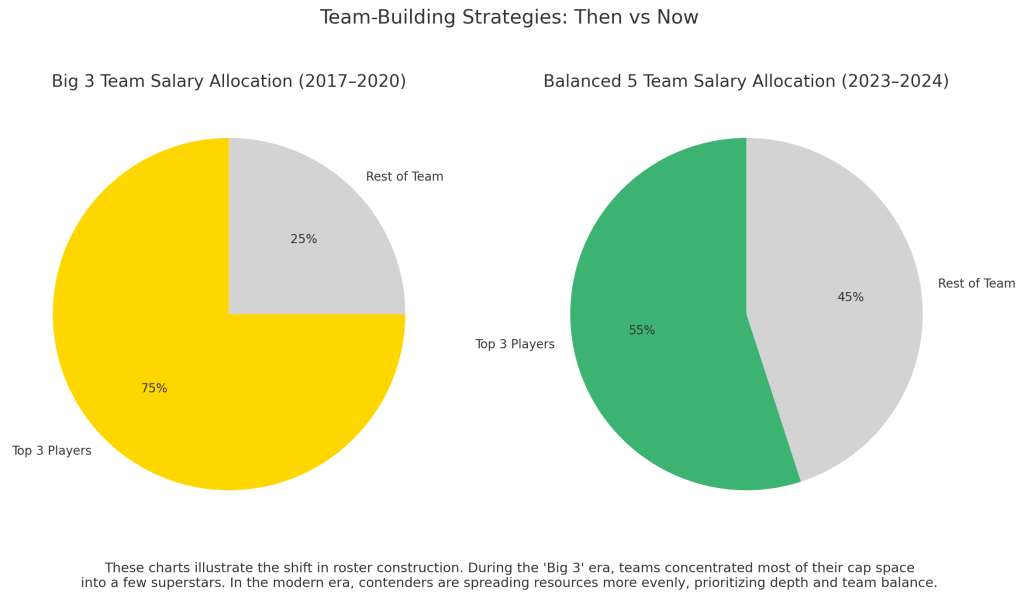
For over a decade, the league revolved around predictable contenders. Whether it was LeBron-led super teams, the KD-Curry Warriors, or short-lived powerhouses like the CP3-Harden Rockets, we mostly knew who the championship window belonged to. And with that came blockbuster trades, lopsided free agency moves, and high-octane drama.
But now — LeBron, Kyrie, Durant, Kawhi, Chris Paul, Curry, Lillard, Westbrook, and Paul George are all reaching the twilight of their careers. This isn’t just a changing of the guard — this is a full-on reset. The NBA’s new era isn’t about collecting stars; it’s about building sustainable success through depth, chemistry, player development, and smart coaching.
For many fans, this transition won’t be easy. We’ve been spoiled — watching generational talents clash on the biggest stage, fueled by narratives that practically wrote themselves. But for true basketball enthusiasts, this new era is a breath of fresh air. We’re entering a time where “average” teams on paper can play elite basketball as a unit.
This is a return to the beauty of the game itself — spacing, ball movement, on-court communication, trust, and role players doing their jobs at a high level. It’s not sexy, but it’s effective. It’s less about top-heavy rosters and more about well-rounded, intelligently constructed teams.
What’s even more exciting is that in this new version of the NBA, every offseason move matters. It doesn’t have to be a blockbuster trade — sometimes, it’s about acquiring a key rotational player, drafting wisely, or hiring the right assistant coach. The margin for error is smaller, but the room for impact is larger. A non-headline move can shift the entire trajectory of a franchise.
We’re already seeing it. The Knicks, for example, have leaned heavily on culture and chemistry. The Magic and Timberwolves have prioritized youth development and defense. Coaching is under the spotlight again — no longer just about managing egos but drawing up smart plays, adjusting on the fly, and fostering belief in the system.
Even the media is being forced to evolve. For years, coverage centered around a handful of superstars. LeBron’s every move. KD’s tweets. Curry’s legacy. CP3’s title chase. These storylines wrote themselves and dominated headlines. But now, with parity increasing across the league, the media is going to have to shift from chasing superstar drama to understanding teams. They’ll have to dive deeper — into coaching styles, bench dynamics, and player development arcs. There are no more default narratives. Everything has to be earned and analyzed.
This is “The Great Reset.” And while it may not have the flash of the previous era, it brings something arguably more compelling — unpredictability, balance, and a renewed focus on the game itself. The NBA is no longer just about who has the most stars — it’s about who plays the best basketball.
And that, in many ways, is what the sport has always been about.
For the next generation of fans and players, this new era offers a powerful reminder: greatness doesn’t always come with fame. It comes from buy-in, consistency, and doing the little things right — over and over again. Young hoopers growing up now won’t just idolize highlight reels or 30-point scorers — they’ll start to see the value in being a glue guy, a smart defender, or the player who makes the extra pass. And for fans, especially those loyal to smaller-market teams, hope is no longer tied to landing a superstar. It’s tied to building something real. The Great Reset levels the playing field — and with it comes a deeper appreciation for basketball in its purest form.


 Wildcard TV
Leave a comment