

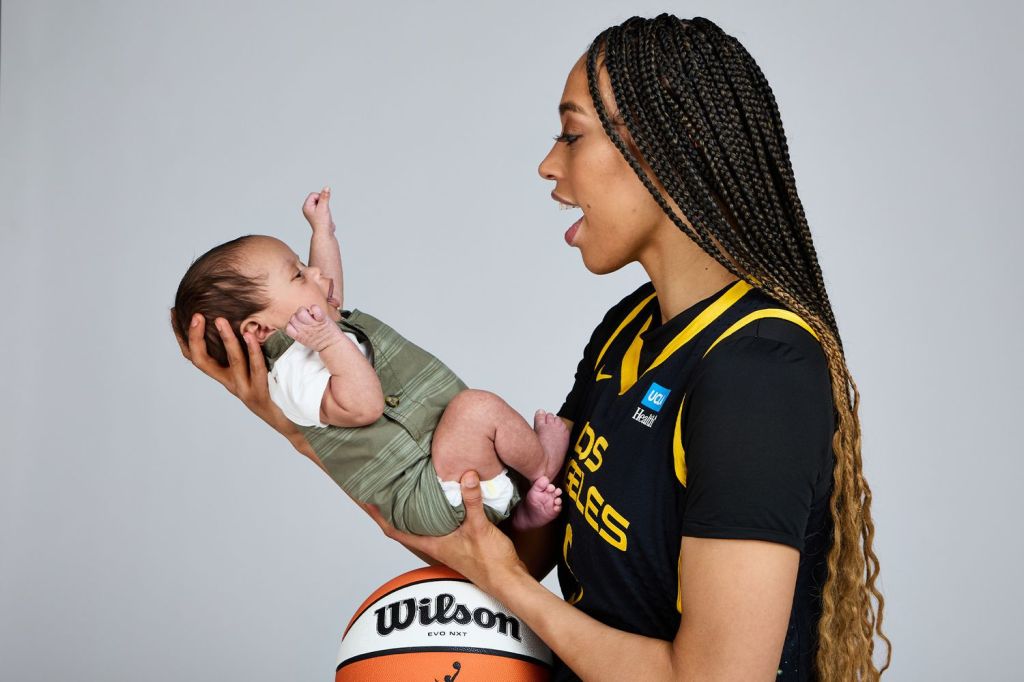
Dearica Hamby, the LA Sparks forward, boasts an impressive list of accolades, including back-to-back 6th Women of the Year awards, being part of the 2022 WNBA Championship team, and earning the title of 2-time All-Star. Nevertheless, her most awe-inspiring achievements extend beyond her basketball prowess. Dearica is a two-time mother to her 6-year-old daughter, Amaya, and her newborn son, Legend, making her journey even more remarkable and worthy of recognition.
During her second pregnancy, Dearica faced numerous challenges, including a difficult pregnancy and a trade from the Las Vegas Aces. numerous challenges that tested her resilience both as an athlete and as a woman. Despite the emotional toll, she boldly addressed issues of pregnancy discrimination on social media, shedding light on the coldness, disrespect, and disregard she experienced with her former team, the Las Vegas Aces. Her unwavering courage sparked an investigation, leading to the suspension of the Aces’ head coach for “Respect in the Workplace” violations.She courageously addressed the issues she encountered with the Aces on social media, expressing her feelings of being “traumatized” by the organization’s coldness, disrespect, and disregard. An investigation into the matter led to the suspension of Aces’ head coach, Becky Hammon, for “Respect in the Workplace” violations. Despite this, the emotional toll was too great, leading Dearica to make a move to the LA Sparks through a trade.
Dealing with pregnancy discrimination within her former team was no easy feat, but Dearica demonstrated incredible determination and resilience while also preparing her family for the transition to a new city and juggling her basketball career.
In a recent interview, Dearica candidly discussed her experiences during both pregnancies. Her first pregnancy was a learning process, as she, like many new mothers, navigated the journey of giving birth and adjusting to motherhood. During her second pregnancy, she delivered Legend three weeks earlier than expected, but fortunately, her pregnancy went smoothly, allowing her to have a natural birth and recover quickly.
One significant difference in her two pregnancies was her approach to breastfeeding. While Amaya was breastfed for the first 11 months of her life, Dearica faced challenges continuing this routine with Legend due to the stress of moving and her busy lifestyle. To address this, she invested in travel pumps, such as the Willow pump, which allowed her to pump efficiently while multitasking during phone calls and other activities. Hamby reached out to Willow because she felt their purposes aligned. She also wanted to speak about the PUMP Act, something they were already working on.
The PUMP Act expands on the 2010 Fair Labor Standards Act to protect nursing moms not previously entitled to a break time and private space to pump at work. The act passed in late April will also allow employees to go after financial compensation if their employers aren’t complying.
Returning to the basketball court just 8 weeks after giving birth was another incredible feat for Dearica. Please take into account that a women’s uterus, which enlarged as your baby grows, will take about six to eight weeks to contract back to normal size. During this process, women may experience cramping, bleeding, a heavier-than-normal period, and/or vaginal discharge and the ability to face postpartum depression. Hamby claims that she was unsure if she wanted to play the season or if she just wanted to miss some time, in which she had never had to do with her two pregnancies due to excellent timing. However, Hamby goes on to speak about even with the level of pride, passion, and dedication she has to being a mother, getting back to the game was something she needed to do. Despite the physical and mental challenges, she was determined to resume playing the sport she loved. Adapting to a new team, balancing motherhood responsibilities, and regaining her confidence proved to be a slow start for Dearica. However, her dedication and hard work eventually paid off, leading to one of her better performances against the New York Liberty, where she scored 21 points, grabbed 6 rebounds, and provided 3 assists.
Finding the right balance between being a new mother and a professional basketball player posed its challenges for Dearica. While she took Legend on longer road trips to maintain her nursing schedule, she had to adjust to not sleeping in the same room during games. Fortunately, her mother’s support has been invaluable during these times.
Dearica’s journey has transcended beyond personal accomplishments; she has become an advocate for women’s rights and equality within the WNBA. Her experiences have shed light on the need for better support for female athletes during pregnancy and postpartum. She firmly believes in empowering women to be both WNBA players and mothers, urging the league to prioritize their well-being and eliminate any fear of discrimination or career setbacks. Dearica’s fight has become something much bigger than herself; she’s fighting for women across the league to be able to be WNBA players but also have their freedom as women. It has been a long history of pregnancy fear for WNBA players because that has always come with too much uncertainty. Dearica’s fighting for women not to have to play an entire season secretly pregnant and get reprimanded by the organization the way Skylar-Diggins did in the 2018-19 season when she was accused her of quitting on the team for not returning quickly from maternity leave. Dearica’s fighting for women to have help from the WNBA during their pregnancy, not add stress to their pregnancy by withholding contract extensions, trading them, or questioning their commitment to the game.
The unequal treatment and double standards regarding male and female athletes starting families reflect the deep-rooted gender biases present in our society. When male athletes become fathers, it is often celebrated as a positive aspect of their personal lives, and they are not expected to sacrifice their careers or face discrimination as a result. In fact, fatherhood is sometimes seen as a source of inspiration and motivation for male athletes, showcasing their commitment to both family and sport.
On the other hand, female athletes often encounter a different reaction when they express their desire to start a family. Many face criticism, skepticism, or even pressure to choose between their careers and motherhood. The notion that becoming a mother could hinder their performance on the field is perpetuated, leading to unfair assumptions about their dedication to their sport. Some athletes may feel forced to conceal their pregnancy or delay starting a family to protect their professional opportunities.
This disparity in attitudes towards male and female athletes’ family decisions is rooted in traditional gender roles and societal expectations. Women are often held to different standards, and motherhood is still viewed as potentially hindering a woman’s ability to excel in her career, particularly in high-performance sports.
To address this issue, it is essential for sports organizations, fans, and the media to challenge these biases actively. Female athletes should be given the same level of support, respect, and accommodation as their male counterparts when they choose to start families. Pregnancy and motherhood should not be viewed as detrimental to an athlete’s career but celebrated as a testament to their abilities to excel both on and off the field. By promoting gender equality and eradicating these discriminatory attitudes, we can create a more inclusive and supportive environment for all athletes, regardless of their gender or family choices. Though, the correlation may not be in plain site, league expansion could be a big part of the change happening.
Expanding the league with more teams could significantly benefit the concerns surrounding women athletes getting pregnant during the season. With a larger number of teams, roster sizes would likely increase, offering more players available to step in and fill the gap if a player needs to take a break during pregnancy or postpartum. This added depth would provide flexibility for managing pregnancies within the team and ease the pressure on individual players. Moreover, a larger league would lead to a more balanced schedule with fewer games per team, reducing the physical and mental strain on players.
This would make it easier for female athletes to manage their pregnancies and have adequate time for postpartum recovery without compromising their performance. Additionally, the expansion could create opportunities for better support systems, including policies and programs that promote a supportive environment for players balancing motherhood and sports. As the league grows, it may lead to a cultural shift in how pregnancy and motherhood are perceived within the sporting world, challenging stereotypes and fostering a more accepting and inclusive environment for female athletes. The increased representation of women athletes as mothers can also drive positive changes within the league and advocate for policies that support their needs during pregnancy and postpartum. Overall, expanding the league with more teams would not only offer competitive and financial benefits but also create a more accommodating and supportive environment for women athletes as they navigate the journey of motherhood while pursuing their sporting careers.
In a sporting world where motherhood has often been seen as a hindrance, Dearica Hamby stands as a beacon of hope and empowerment. Her journey sends a powerful message that women can excel both on and off the court, making a lasting impact as athletes, mothers, and advocates for change. As the WNBA continues to evolve, Dearica’s legacy will undoubtedly inspire a new era of female athletes, where motherhood is celebrated and embraced as a natural and viable choice from the outset. Out of the 144 WNBA spots, only 10 women are mothers. The aspiration is that the upcoming generation of female professional athletes won’t have to justify why supporting motherhood is essential; rather, motherhood will be seen as a natural and viable choice from the outset.



 Wildcard TV
Leave a comment